How the cup node works
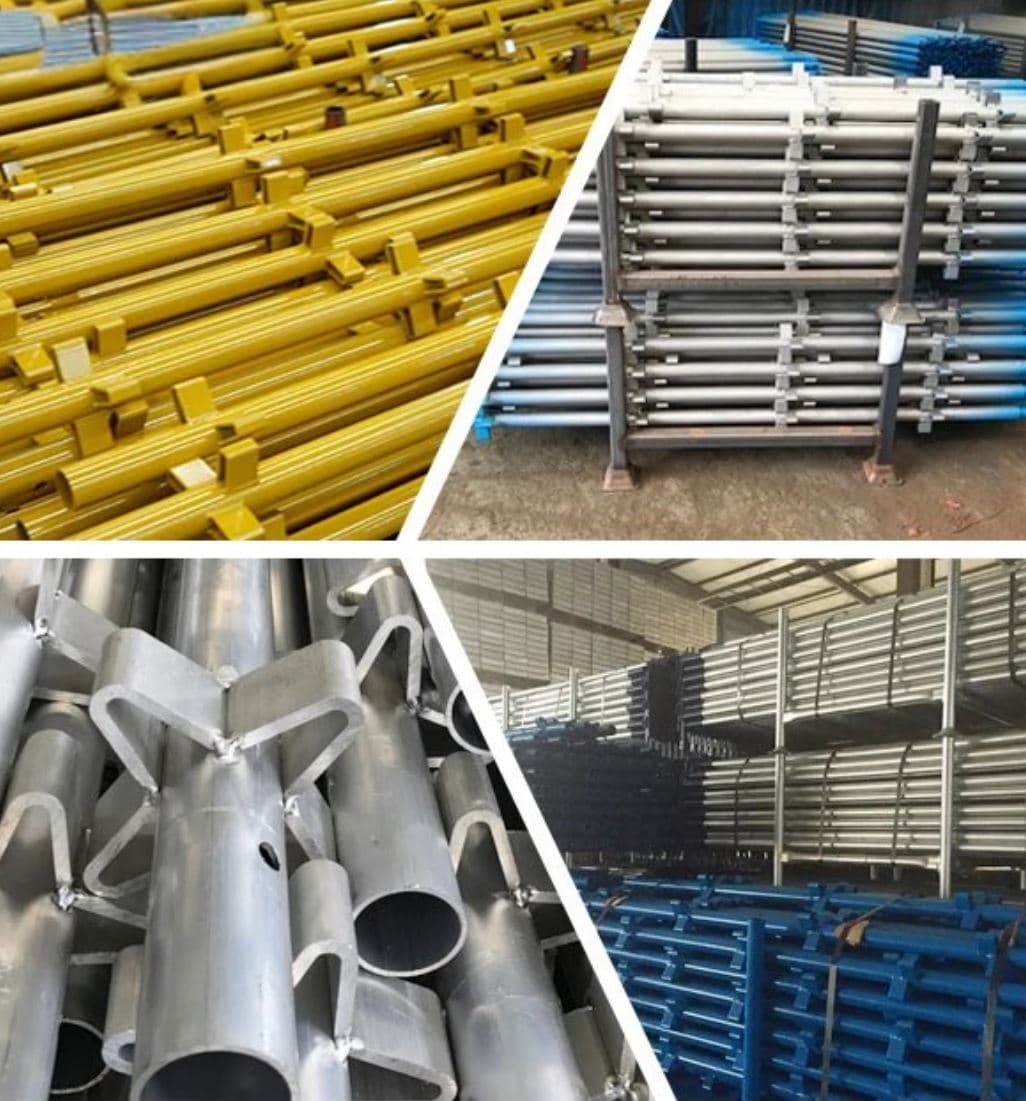
Every cuplock standard carries a series of fixed lower cups welded on at regular intervals along its length, with a loose upper cup above each one that can slide up the tube and turn. The ends of the horizontal members — ledgers and transoms — are shaped into blades that drop into the lower cup. Once the blades are seated, the upper cup is slid down over them and struck round with a hammer until it locks.
That single action is the point of the system. Several horizontal members can be locked into the same node at once, from different directions, without a coupler, a bolt or a spanner. The node is either locked or it is not, which is easy to see from the platform and easy to check at inspection.
Because the cups are fixed to the standard at the factory, the heights at which horizontal members can connect are fixed too. The lifts of a cuplock scaffold therefore come in steps set by the spacing of the cups, rather than at any height a scaffolder chooses — a constraint that matters later when a structure does not suit the steps.
The components of a cuplock system
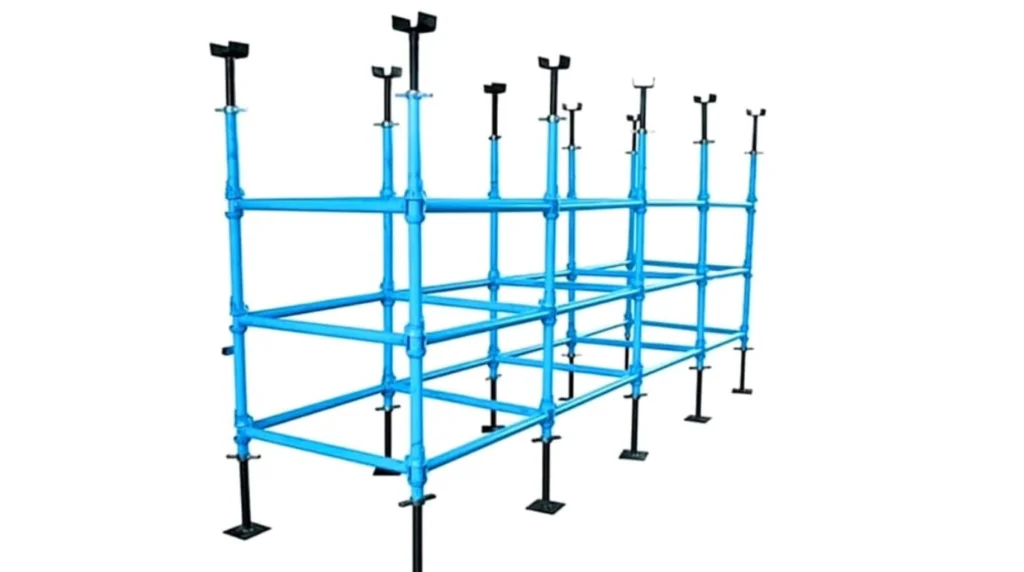
A cuplock scaffold is built from a short list of parts. Standards are the vertical tubes with the cups on them, joined end to end by spigots. Ledgers run horizontally along the scaffold between standards; transoms run across it and carry the boards; intermediate transoms add support under the boards where the spans are longer. Diagonal braces stop the frame racking.
At the base, each standard sits on an adjustable base jack so the scaffold can be levelled on uneven ground, normally on a sole board that spreads the load. When the system is used for support work, adjustable U-heads at the top of the standards take the beams or formwork above.
Platforms are completed with boards, guardrails and toe boards in the usual way, and the scaffold is tied to the structure where the design calls for it. The vocabulary for all of these parts is set out in the components and terms guide.
Where cuplock is used: access and shoring
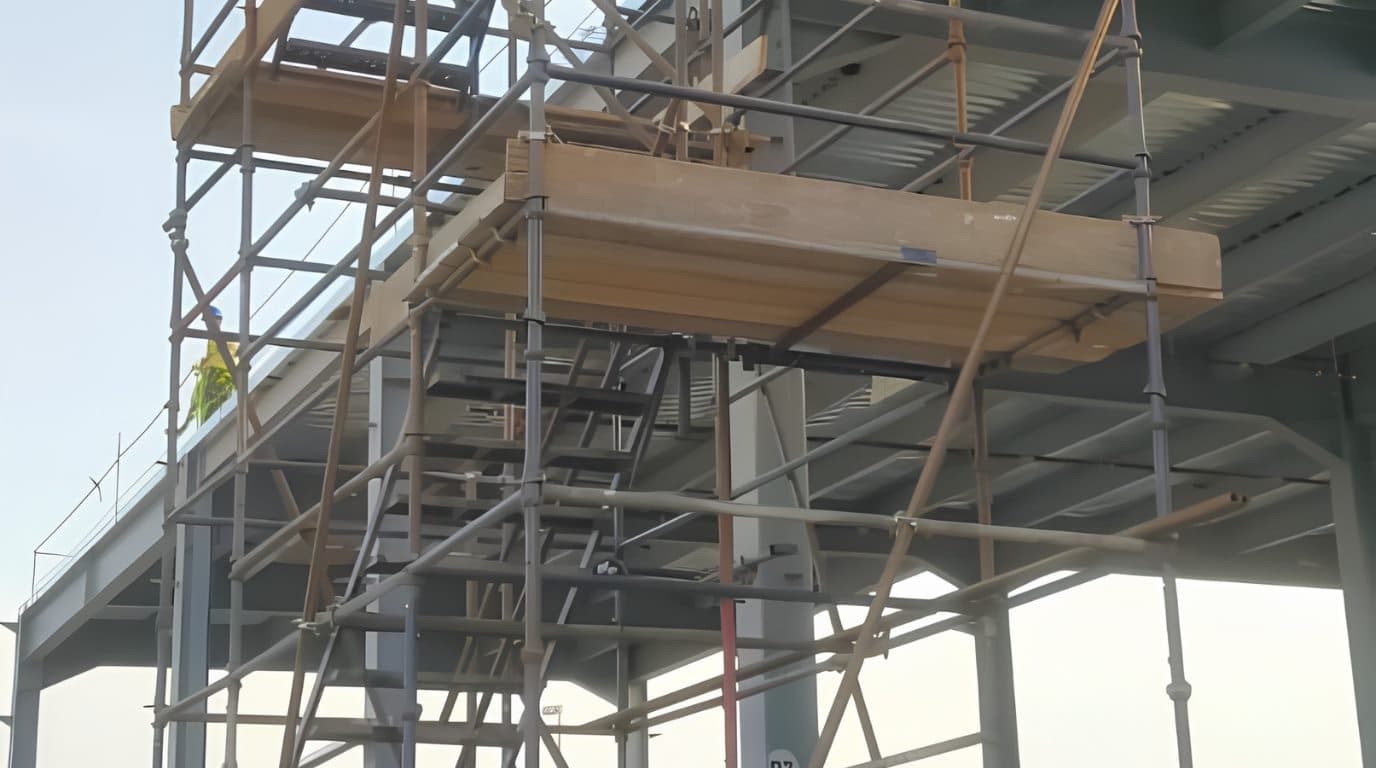
As an access scaffold, cuplock suits facades, slab edges, plant and any job where the same bay sizes repeat along a run. The fixed nodes give a consistent, square structure that goes up quickly once the base is set out, and the absence of loose fittings reduces the number of small parts to be carried, counted and lost.
As a support system, the same components are configured into shoring: closely spaced standards with braced lifts, jacks at the base and U-heads at the top, carrying formwork, a slab being poured or an element under repair. This is a different structure doing a different job, and it is designed for its loads rather than adapted from an access layout.
Many sites use cuplock for both at once — access around the outside of a frame and shoring beneath its slabs — because the material, the training and the stock are shared.
Strengths and limits of a fixed-node system
The strengths come from the node. Erection is fast, connections are consistent, the structure is easy to inspect, and fewer loose components travel round the site. For regular structures and repeated bays, those advantages add up quickly over a long run.
The limits come from the same place. Because lift heights follow the cup spacing, the scaffold cannot place a platform at an arbitrary level, and irregular geometry — a stepped facade, a vessel, a congested pipe rack — is harder to follow than with tube and fitting. Many cuplock scaffolds therefore include tube-and-fitting infill where the structure stops being regular.
Load capacity depends on the configuration — the bay sizes, the lift heights, the bracing and what the scaffold stands on — not on the name of the system. That is a design question, answered for the job rather than assumed.
What to ask for when ordering cuplock
Ask for a material list rather than a quantity. A good one lists the standards, ledgers, transoms, braces, jacks and U-heads by length and count, the boards and edge protection, and the ties — all drawn from a layout for your structure.
Ask about the finish. Cuplock components are supplied galvanised or painted, and the choice matters for scaffolds that stand outdoors for a long time or near the coast.
And ask who erects it. The system is quick in trained hands, but the node only does its job when the blades are seated and the cups are struck home; a supplier that also erects and inspects the scaffold is answering for that as well as for the material.