Tubes, couplers and boards: the parts
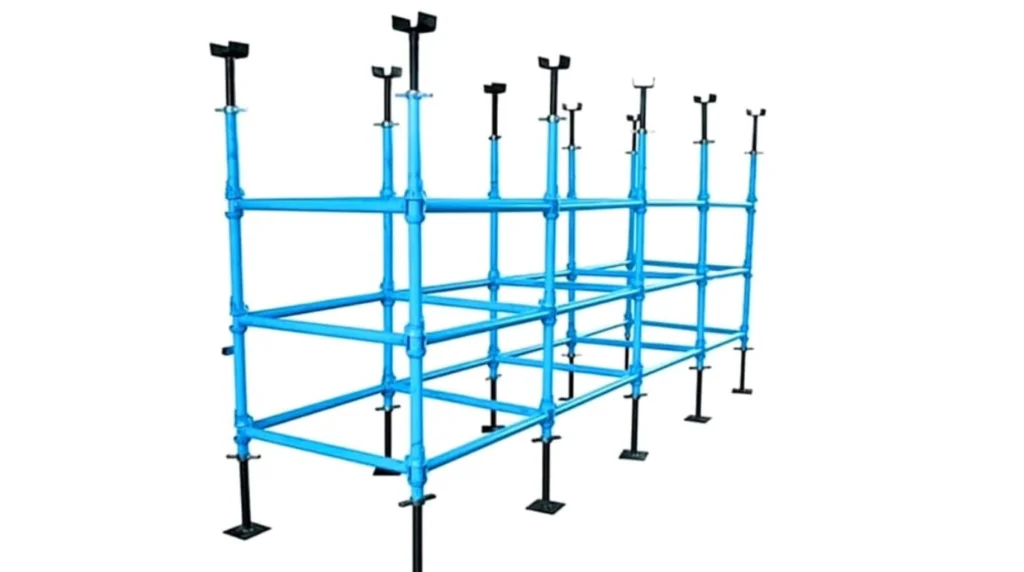
A tube and fitting scaffold has three families of parts. The tubes are plain steel scaffold tubes in a range of lengths, used for every structural member — standards, ledgers, transoms, braces and ties alike. The fittings, or couplers, clamp tubes together. And the platform is made up of boards, guardrails and toe boards, the same as any other scaffold.
Different couplers do different jobs. A right-angle coupler joins two tubes at ninety degrees and carries load, which is why it is used where a ledger meets a standard. A swivel coupler joins tubes at any angle and is used mainly for bracing. Sleeve couplers and joint pins join tubes end to end where a member has to be longer than one tube. Putlog or single couplers fix the members that carry the boards.
Base plates sit under each standard, normally on sole boards, and the scaffold is tied back to the structure with tubes and couplers as the design requires.
Why tube and fitting follows any geometry
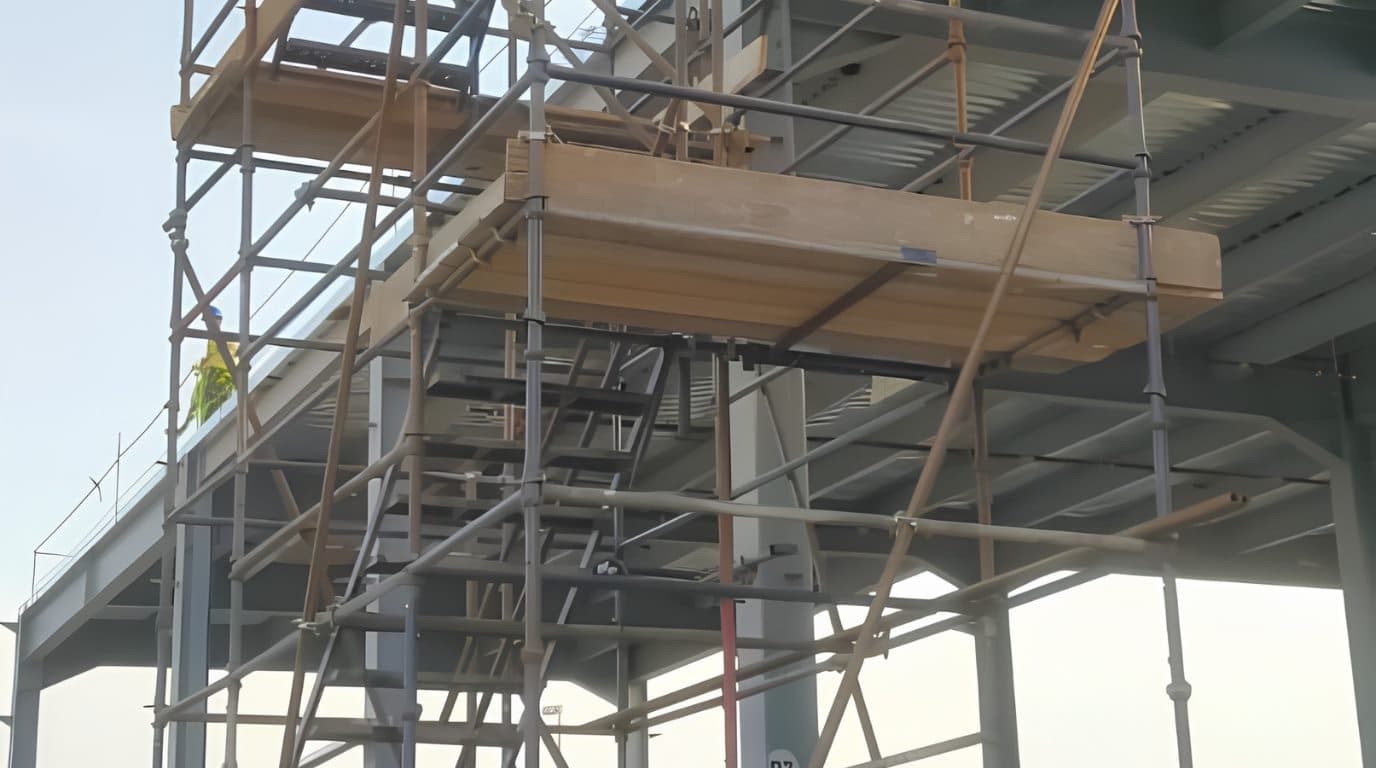
Nothing in a tube and fitting scaffold is fixed in advance. A ledger can be placed at any height on a standard, a transom can be set wherever the structure leaves room for it, and a brace can run at whatever angle the space allows. The scaffold is shaped by the structure rather than the other way round.
That is why it is the usual answer inside plant and refineries, around vessels, tanks and pipe racks, on facades that step in and out, and wherever an existing structure leaves only awkward gaps to build through. A modular system would need constant compromise in those places; tube and fitting simply follows the line of the work.
It is also why tube and fitting so often appears alongside modular systems on the same site, filling in around obstructions where the modular scaffold's fixed lifts no longer line up.
Where it is the right system
Tube and fitting is the right choice when the geometry is irregular, when platforms are needed at specific levels that do not match a modular system's steps, and when the scaffold has to be altered often as work moves around plant that is still in operation.
It is less efficient on long, regular runs. Where the same bay repeats for a hundred metres along a facade, a modular or frame system goes up faster with fewer people, and the flexibility of tube and fitting is not being used.
The decision is often made face by face rather than for a whole site: modular where the structure is regular, tube and fitting where it is not.
The trade-off: labour and supervision
Flexibility has a cost. Every joint in a tube and fitting scaffold is made by hand, so the system takes more time to erect and more skill to erect well than a modular one. Couplers have to be the right type for the joint, positioned correctly and tightened properly, and a scaffold with hundreds of joints has hundreds of places where that can go wrong.
That is why tube and fitting depends so heavily on trained scaffolders and on supervision during erection, and why its inspection looks closely at couplers: missing, loose or wrongly chosen fittings are among the first things an inspector checks.
The design matters for the same reason. Because the scaffold can be built in almost any shape, it needs a drawing that fixes the shape that will actually carry the loads — bay sizes, lift heights, bracing and ties — before the first tube goes up.
Galvanised tube for external work
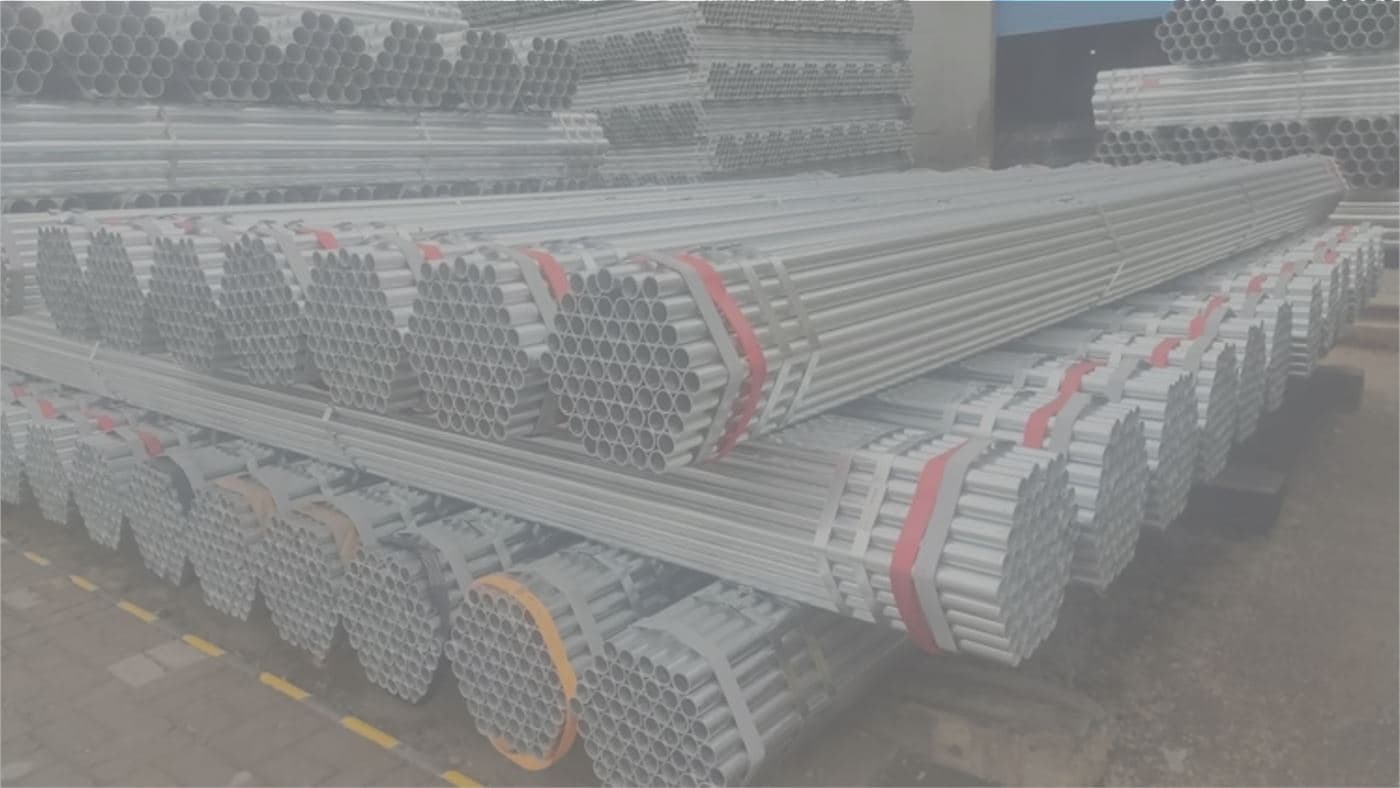
Scaffold tube used outdoors, near the coast or in industrial air is normally hot-dip galvanised, because the zinc coating protects the steel from corrosion over repeated use. The coating ages first, so damaged or heavily corroded tube is taken out of service rather than reused.
Tubes are also cut to length for particular jobs. A cut end has no galvanising, and tube that has been cut, bent or damaged is checked before it goes back into stock.
The difference between galvanised and plain carbon steel pipe — and where each is specified — is set out in the GI pipe guide.