Vertical props and diagonal props
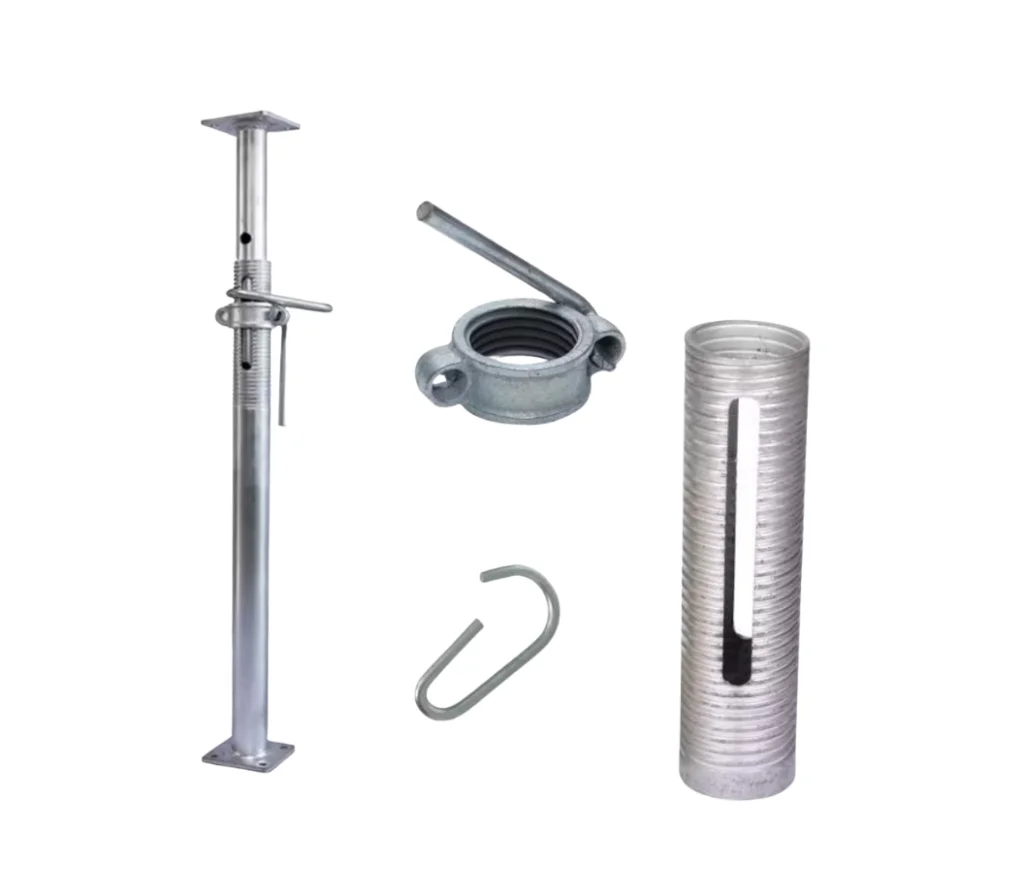
The two props do different jobs. A prop jack — an adjustable steel prop — stands vertically and carries load downwards: the weight of formwork and wet concrete above it, or of a structural element that needs temporary support.
A push-pull prop is set at an angle between the ground or slab and a vertical element. Its job is not to carry weight but to hold the element in line: to keep a wall form plumb, to resist the wind on a tall panel, or to hold a precast or steel element while it is fixed.
Using one in place of the other is a mistake. A diagonal prop is not designed to carry a slab, and a vertical prop does nothing to stop a wall form leaning.
How the thread adjusts and locks
Both kinds of prop combine a sliding tube with a threaded section. The tube gives the rough length; the threaded collar gives the fine adjustment, raising or lowering the prop in small steps until it is tight against what it supports.
On a vertical prop, a pin through the tubes sets the rough height and the collar then takes up the gap. On a push-pull prop, turning the threaded section pushes or pulls the element it is fixed to, which is how a wall form is brought exactly plumb.
Threads have to be kept clean and undamaged to work smoothly, which is why props used around concrete are cleaned after use and checked before they go out again.
Props in formwork
Under a slab, vertical props carry the beams or panels that hold the concrete until it can support itself. Their number, spacing and arrangement come from the formwork design, which accounts for the weight of the concrete, the formwork and the work being done on top of it.
Against a wall form, push-pull props hold the face plumb while the form stands empty and while it is poured. They are fixed to the form at one end and to the ground or slab at the other, at the positions the formwork design sets.
In both cases the props are part of the formwork system, not an add-on. A form is designed with its props, and changing them changes the design.
Setting props: bases, plumb and spacing
A prop is only as good as what it stands on. Each one sits on a firm, level base — a slab, or a sole board on suitable ground — so its load reaches something that can carry it.
Vertical props are set plumb, because a prop leaning out of line carries load less effectively and can be pushed further out of line. Their heads are seated squarely under what they support, with the matching fittings where the design calls for them.
Spacing follows the design. Adding or removing props, or moving them to make room for other work, is a change to the temporary works and is agreed before it is made.
Releasing props in sequence
Props are released when the engineer responsible confirms that what they support can carry itself, and in a planned order rather than all at once. Releasing in sequence lets the load transfer gradually and shows early if something is not ready.
A prop that is hard to release can be telling you that it is still carrying load. That is a reason to stop and check, not to force the collar.
On this site, prop jacks and push-pull props are published as part of the steel range, supplied with the matching couplers and threaded tube, for hire or purchase alongside the formwork they support.