The buy-or-hire decision is a programme decision
Whether to hire scaffolding or buy it is usually argued about as a cost question. Most of the time it is a programme question: how long the material will be in use, and what happens to it between jobs. Get that answer right and the cost answer usually follows, because the costs on each side are not the ones printed on the quotation.
Buying carries the purchase price plus everything that follows it — somewhere to keep the material, transport to and from each job, inspection and repair, and the replacement of what is lost. Hiring carries the hire charge plus nothing else, because the yard, the transport, the condition of the material and the maintenance sit with the supplier.
The two are not opposites, and a mixed programme often needs both: a core of material the company keeps because it is always in use, and hired material for the peaks that a purchase list would leave sitting idle for the rest of the year. Where the programme is mixed, both should be quoted so the comparison can be made line by line rather than by feel.
The time the site gets back
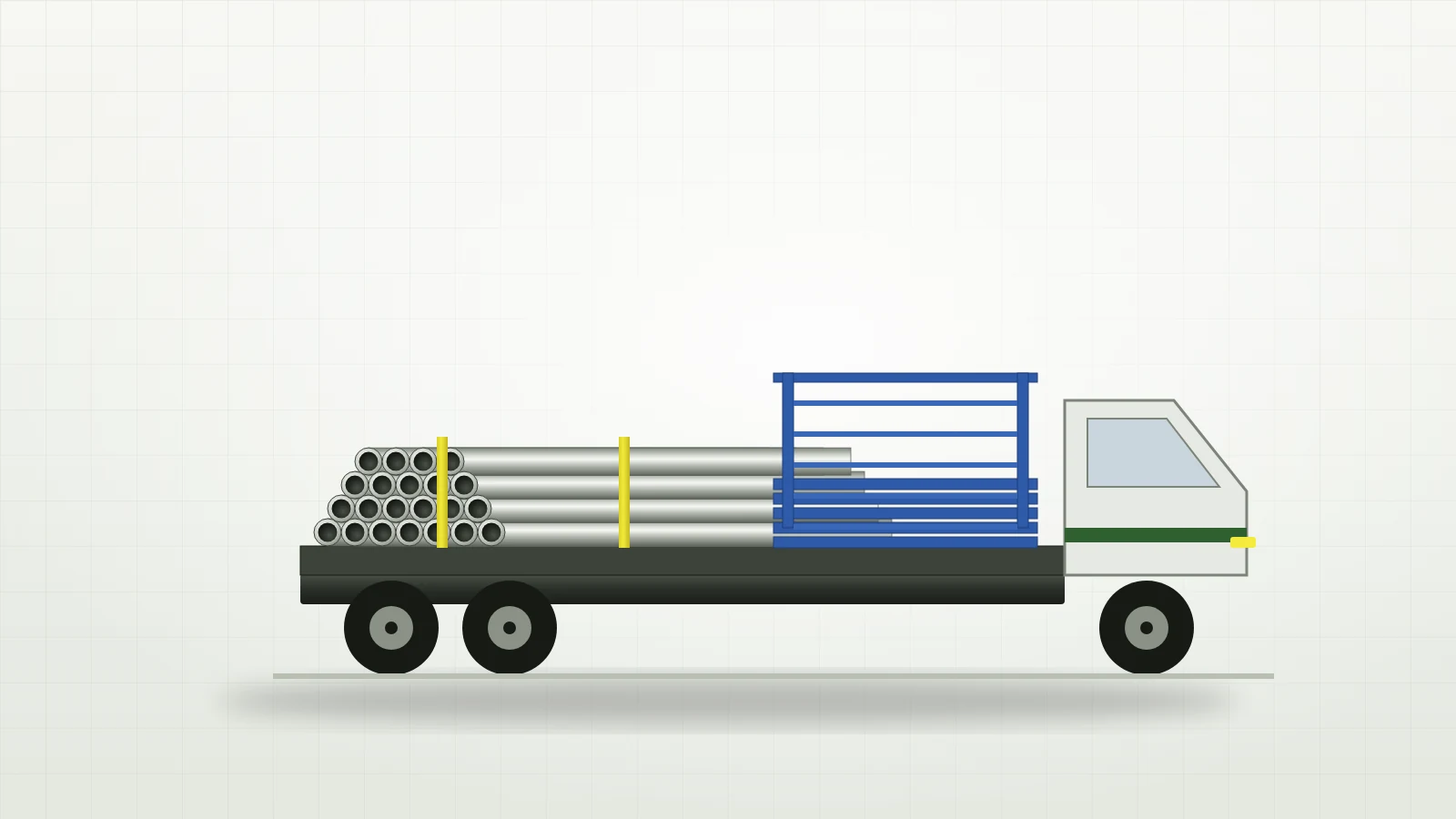
Hiring moves work off the site and onto the supplier. Delivery is arranged to the programme rather than booked around the site's own transport; on collection, the material leaves; and between the two, none of the site's people are counting, sorting, checking or chasing it.
The saving is clearest at the edges of a job. At the start, hired material can be mobilised quickly because it is stock rather than an order, so the access is not the reason the programme slips. At the end, striking and collection are somebody else's logistics, and the site is not left with a pile of tube and boards and a decision about where it goes.
There is also a maintenance effect that is easy to overlook. Hired material is checked and, where components are damaged, replaced before it goes out again, so the site receives material that is fit to build with rather than material that has been in a container since the last project. The condition of what arrives is one of the practical differences between the two options, and it is worth seeing a full delivery rather than a sample before a first hire.
What each option actually costs
Purchase price is the visible part of owning scaffolding and rarely the largest part over several years. Add the storage: a yard or a store that is rented, secured, insured and managed, in a market where industrial space is not cheap. Add transport in both directions for every job. Add the labour to load, sort and check. Add inspection and repair, and add the components that quietly disappear on site — tube, boards, couplers and fittings are lost, borrowed and left behind on almost every project.
Against that, the hire charge is a single line with an end date. It is higher than the depreciation on material that is working, and lower than the total cost of material that is not: a purchased set that is used for a few weeks a year is the most expensive scaffolding on the books.
The comparison is worth doing with real numbers — the hire rate over the expected duration, against the purchase price plus the annual cost of storing and maintaining it. Over one short job the answer is nearly always hire. Over a programme of several years, with the material in use most of the time, the answer moves the other way. Where there is genuinely a tie, that is useful information rather than a failure: it means either option will do, and cash flow can decide.
When buying makes sense
Buying earns its place where the material stays in use. A contractor with continuous access work — a maintenance fleet, a rolling programme of facades, teams that erect and strike all year — reaches a point where the purchase price is spread over so many jobs that hire is no longer competing on cost alone.
It also suits standardisation. Material that is owned can be kept to one system, in known quantities, with spares held in the same yard; that consistency is worth something on sites where the crew moves between jobs and a missing component should not stop the work.
What buying needs, though, is somewhere to keep it and a routine to look after it. Without a yard, a stock check, a cleaning and inspection habit and a repair plan, purchased scaffolding deteriorates into a liability: material that is technically owned, effectively unusable, and still costing storage. Hire has no such cliff.
A useful way to put it: rent for demand, buy for steady state. Where a project is a one-off, or where the size of the access requirement changes through the year, hire keeps the cost proportional to the work. Where the requirement is permanent, ownership eventually pays for itself — and the only way to know which applies is to look at the last twelve months of jobs rather than the next one.
Getting a comparison worth reading
To get a quotation that can actually be compared, send the duration, the structure to be accessed, the height involved, whether the access has to move as the work progresses, and whether you want the material installed and dismantled or supplied only. A drawing or a sketch of the elevation helps at the quotation stage; where there is no drawing, a site inspection establishes the same facts by looking at them.
That last point matters more than it sounds. Quantities that come from a real drawing or from a site visit match the job in front of you, which means the hire is neither short nor padded — and a hire that is neither short nor padded is the cheapest one on the invoice, whatever the rate.
Both options can carry the same terms on delivery, collection and the condition of the material, and both can be quoted together on one document. The decision belongs with whoever holds the programme and the yard, and the information it needs is the list above.