Why the choice of material is a site decision
Aluminium and steel scaffolding both hold a platform in the air. They differ in how that platform is moved, how far it can span unsupported, and how the metal behaves out in the weather. The useful question is not which material is better in general, but which one suits the job in front of you.
Four answers decide it: how the material will be moved, what the platform has to carry, how long the scaffold will stand, and what it is standing in. Where those answers agree, the choice is straightforward. Where they conflict — a long elevation that also has to be carried through a building, for example — the answer is usually a designed mixture of the two, which is what a material list exists to record.
This article sets out how aluminium and steel behave in the terms a site team actually works in: handling, load, corrosion, and the practical checks that follow from them. The exact weights, spans and permitted loads of a particular system come from that system's own design data, so the figures for your job should come from the design rather than from a general rule.
Weight and handling: what changes on site
Aluminium's advantage is its strength-to-weight ratio. A component light enough to be lifted by one person can be carried through a doorway, up a stairwell or between floors, and a short tower can be built, moved and struck by a small team without a crane or a hoist. That is why aluminium systems are the usual answer inside a building, where the material has to travel with the work.
Steel components are heavier, so on long elevations and heavy-duty work the material is normally moved mechanically or by a larger team. This is not a defect — it is the trade-off that buys the stiffness and the load capacity described below, and on a facade that is scaffolded once and worked for months it is rarely the deciding cost.
The safety argument for lighter material starts with the movement itself. Lighter lifts are easier to control, the awkward postures that strain backs and shoulders are shorter, and fewer people are exposed while an unboarded frame is being assembled. The exception is the one that catches people out: material that is easy to carry invites one-handed carries up ladders, which is the practice a method statement exists to rule out.
Exact component weights depend on the system and the section sizes, so they are worth asking for rather than assuming. A supplier should be able to give the material list with the weights on it, which is also the document that tells the site how many people and what plant the erection needs.
Strength, stiffness and what the platform carries
Steel is stiffer. It holds its shape across longer spans and under heavier loads, which is why it is the material behind heavy-duty access on plant, refineries and structural work, and why it is used wherever material is stacked on the platform rather than simply carried up to it.
Aluminium systems are at their best on lighter, shorter-duration work: a tower for maintenance, a platform for finishing trades, a run that has to be moved along as the work front moves. Within those jobs the weight saving is the point, and the loads are the loads a design has to check anyway.
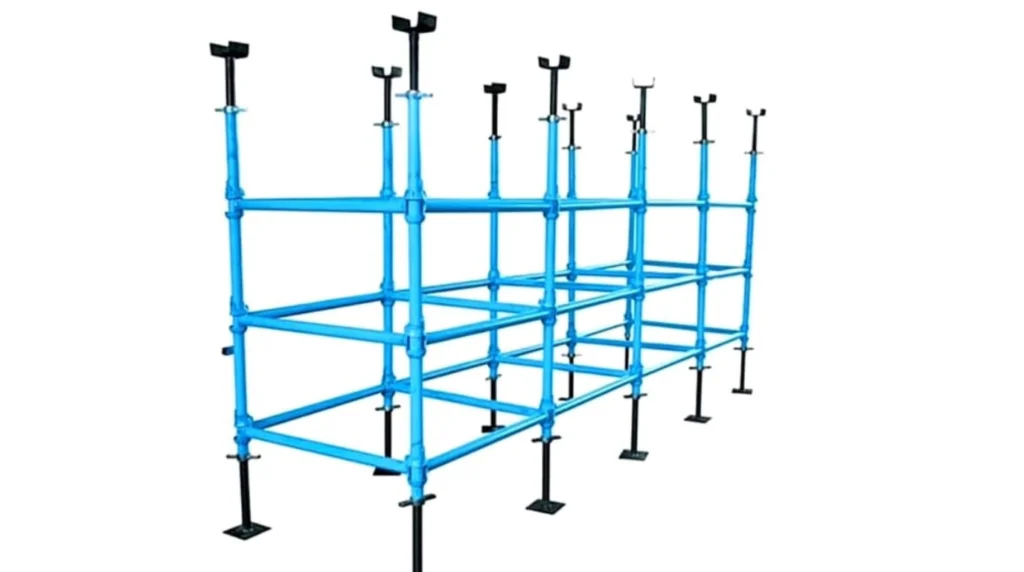
What matters more than the material is the design. A scaffold's permissible load comes from the way it is built — standards, ledgers, transoms, ties, the foundation it stands on and the number of boarded lifts — rather than from the tube it is made of. The duty required for a specific job is a design decision, and it is the reason a scaffolding quotation should be read together with the drawing and material list behind it.
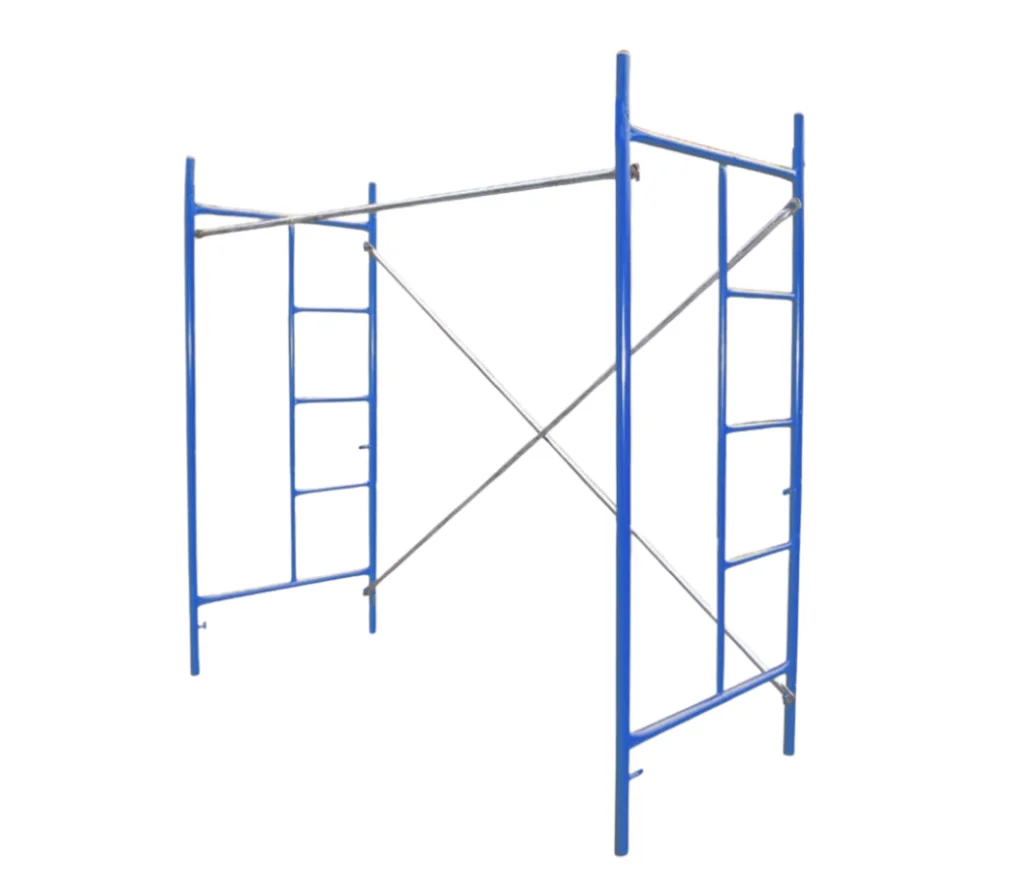
Geometry decides some jobs before material does. Where the structure is irregular — a plant room, a stair void, a facade that steps in and out — tube-and-fitting can be shaped to fit where a modular frame cannot, in either metal. That is a point in favour of the system, not of the alloy.
Corrosion, coatings and Gulf coast conditions
Hot-dip galvanised steel carries a zinc coating that protects the steel beneath it. The coating is what ages first, so the condition of the surface — scratches, dents, cut ends and the white rust that forms where moisture sits against galvanising — is what decides how long the material looks and performs well. The finish is chosen to suit the site: galvanising is the usual answer outdoors and near the coast, and powder coating is used where a finish is wanted on top of the protection.
Aluminium does not depend on a coating. It forms its own protective oxide layer, which is why it is used in coastal and humid conditions. That is not immunity: aluminium still corrodes in some environments, and material left with mortar, concrete, salt or dust on it will deteriorate faster than material that is cleaned. Both metals want washing rather than storing dirty.
The interaction between the two matters. Where aluminium and steel are in contact and water is present, the pair can corrode galvanically, so interfaces are isolated and the system's own assembly instructions are followed rather than improvised.
In the United Arab Emirates the environment does a lot of this work on its own: airborne salt near the coast, dust and sand that hold moisture against the surface, and sun that ages coatings all year round. Material stored on site, or left standing through a shutdown, needs cleaning and inspection in those conditions whichever metal it is.
Choosing a system, step by step
Work through these in order, because each answer narrows the next. How will the material be moved — by hand through the building, or mechanically at the face? What will be on the platform: people and tools, or material as well? How long will the scaffold stand, and will it be struck and re-erected in stages? What is it standing on and against — ground, a slab, an existing structure, a finished elevation that must not be marked? Who erects it, and is the access to be handed over to other trades? Will the material be used again on this project, or hired for one job?
Aluminium normally wins on how the material moves and how briefly it stands. Steel normally wins on what the platform carries and how long the run is. Availability matters as much as the arithmetic: material already in stock can be on site this week, while anything made to order lets the programme set the date instead.
There is no universally better material, and no answer that survives being applied to every site. Aluminium earns its place where the scaffold is carried, moved and struck by hand; steel earns it where the platform carries weight across long spans and stays up while the work goes on around it.
Either way, ask for the design and the material list for your job rather than a generic package. Those two documents answer the handling, the duty and the quantities at the same time — and if what arrives on site does not match them, they are what the conversation is settled with.