Why a finished building needs a different kind of access
On a building under construction, access usually comes from the ground: a scaffold is built up the face, the work is done from it, and it is struck when the job is finished. On a completed building the same approach runs into a different set of constraints — an occupied entrance, a finished facade that must not be marked, landscaping or a podium at the base, and sometimes simply no room to stand a scaffold up.
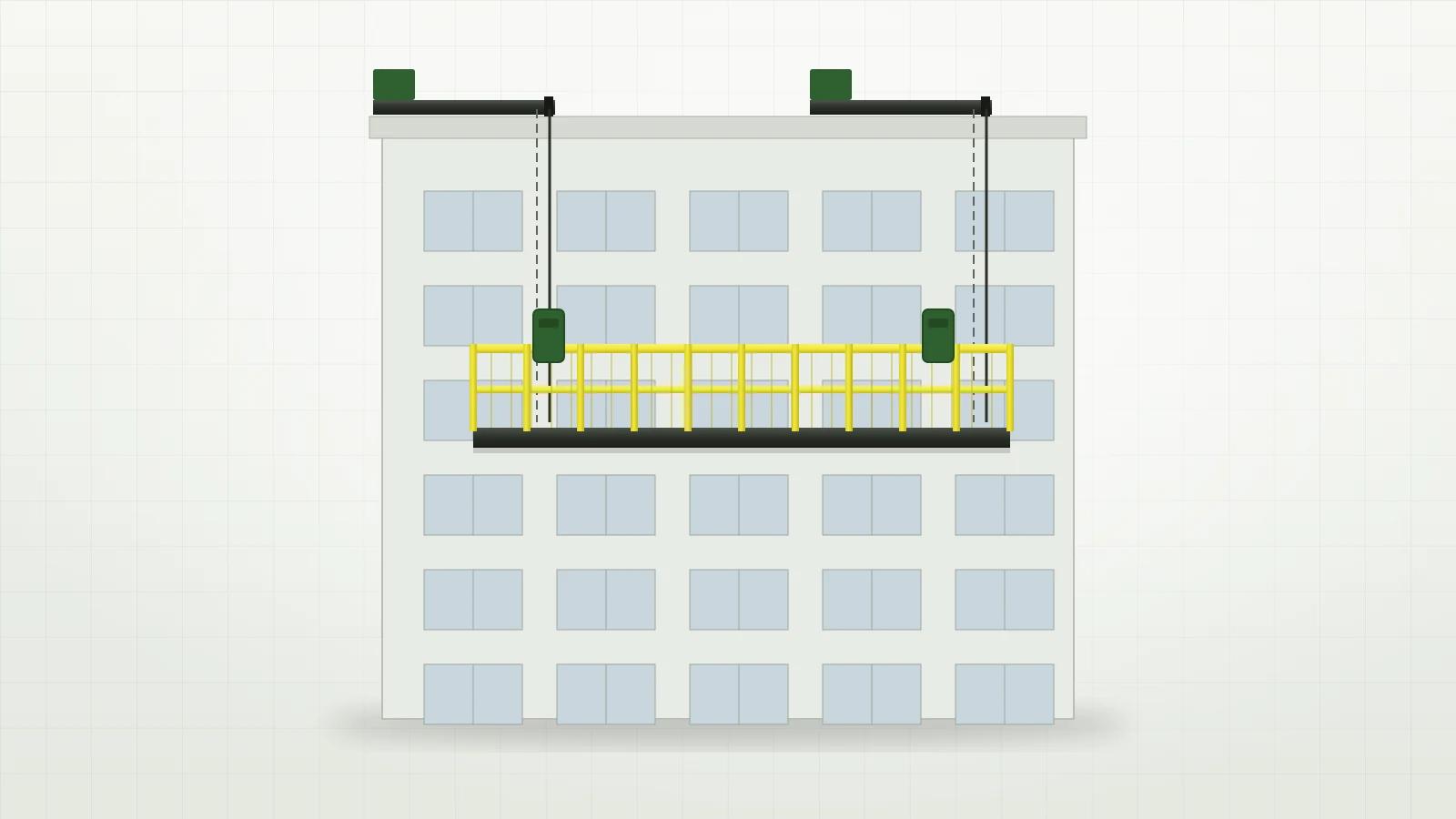
Suspended access answers that. A platform hangs from the structure above and is raised and lowered on the face of the building, so the working position moves vertically instead of the scaffold being built and struck around it. Electric cradles — suspended platforms with powered hoists — are the common form for facade work: cleaning, painting, glazing, cladding repairs and inspection.
This article explains how that equipment is arranged, what has to be in place before it is used, and where a cradle is the better answer than a scaffold — and where it is not. It describes the category rather than any particular machine: the capabilities, limits and instructions of the equipment actually proposed belong to that equipment's own documentation.
Safe access at height: suspension and safeguards
Everything about a suspended platform depends on what holds it up. The arrangement starts at the roof or the parapet: the platform hangs on ropes from a suspension rig, and the rig has to be supported by something capable of taking the loads — a substantial parapet or slab, a purpose-made counterweighted arrangement, or a designed steel support where the building offers nothing suitable. The roof structure, not the platform, is usually what decides whether suspended access is possible at all.
On the platform itself the safeguards are part of the equipment rather than an add-on: secondary or back-up suspension alongside the primary, a device that stops the platform if it travels too fast or a rope fails, travel limits, and an anchored point inside the platform for the operators' harnesses. The exact fit and function belong to the equipment's own instructions, which is why the people who assemble and use it have to know that specific machine.
Then there is the routine around it: the platform is assembled and checked by competent people before first use, the suspension and the anchors are verified against the intended arrangement, the area beneath stays clear while the platform moves, and the arrangement is inspected at intervals and after anything unusual — a wind event, an impact, a repair.
Moving the platform instead of building a scaffold
The efficiency of a cradle is vertical movement. Once the platform is up, going from the fifth floor to the fifteenth is a matter of operating the hoist; with a scaffold, that reach would have been designed, erected, boarded and later struck. On a tall elevation the time is saved in the structure, not in the work.
The other efficiency is at ground level. A cradle needs a small footprint: the rig at the top, the platform at the face, and a clear area beneath while it moves. There is no scaffold standing on the pavement, no external tying into the facade, and far less disruption to a building that is still in use — which on an occupied tower or a hotel under renovation is often the deciding factor.
What it does not do is multiply the workforce. A platform carries a small team with their tools and materials, and the work moves up the face in a defined band rather than across several fronts at once. For a long programme on a wide elevation a scaffold still allows more trades to work simultaneously, and that trade-off is worth working out before assuming the cradle is faster overall.
Where a cradle costs less, and where it does not
A cradle is usually cheaper when the work is a thin band moving up a tall face, because the alternative is a lot of scaffold standing for a comparatively small area of work. Facade cleaning, painting, sealant replacement and window work fit that description, particularly on high-rise buildings where the scaffold would be large and slow to build.
It is usually more expensive — in time if not in money — when the work needs a wide working platform, when material has to be stored and handled on the platform, when loads are heavy, or when several trades need to work at different levels at the same time. Those are scaffold jobs, and no amount of vertical efficiency changes that.
The comparison also depends on the building. If the roof or parapet cannot take the suspension loads without additional support, the cost of making it suitable is part of the cradle option — and where that work is significant, a scaffold or an access tower can become the cheaper answer again.
Flexibility across building types
Suspended platforms suit buildings where the alternative does not fit: towers with a straight elevation, low-rise blocks where a scaffold would block an entrance, long facades where a moving platform is quicker than a scaffold struck and rebuilt as the work progresses, and buildings with a footpath or a road directly against the face that has to stay in use.
They are less suited to complicated geometry. Where a facade steps in and out, where there are projections and balconies at the working line, or where the parapet is fragile, the arrangement either needs additional supports or the platform cannot reach the whole face. Those are the jobs where a designed scaffold — often in tube-and-fitting, shaped to the building — remains the sensible answer.
Many projects use both, deliberately: a cradle for the main elevation and a small scaffold or tower for the entrance canopy, the podium or a face the platform cannot reach. The decision is per face rather than per building.
Maintenance over the equipment's service life
Suspended access equipment is mechanical, and like all mechanical equipment its reliability comes down to maintenance. Wire ropes wear fastest and decide how safe the arrangement is, so they are inspected and replaced on the schedule the manufacturer sets rather than when they look wrong. Hoists, brakes, the fall-prevention device and the electrical supply each have their own servicing routine and their own records.
That matters beyond the current job. The equipment changes hands, is stored between projects and may be assembled differently on the next building, so the paperwork that travels with it — the service history, the inspection records and the assembly instructions — is part of the equipment's value. Platforms that are looked after keep performing; platforms that are not become a risk that has to be managed at height.
For a building owner or a facilities team the same discipline applies in reverse: whatever hangs on the facade should be assembled, inspected and operated by people who know the machine, with the records to show that it was.
When suspended access is the right specification
A cradle is the better answer when the work is thin and vertical, the elevation is tall, the building is finished or occupied, the ground has to stay clear, and the roof or parapet can carry the suspension. It is the wrong answer when the work needs width, storage or heavy loads; when several trades need the same face at once; when the facade is too irregular for a platform to cover; or when there is nothing adequate to hang it from.
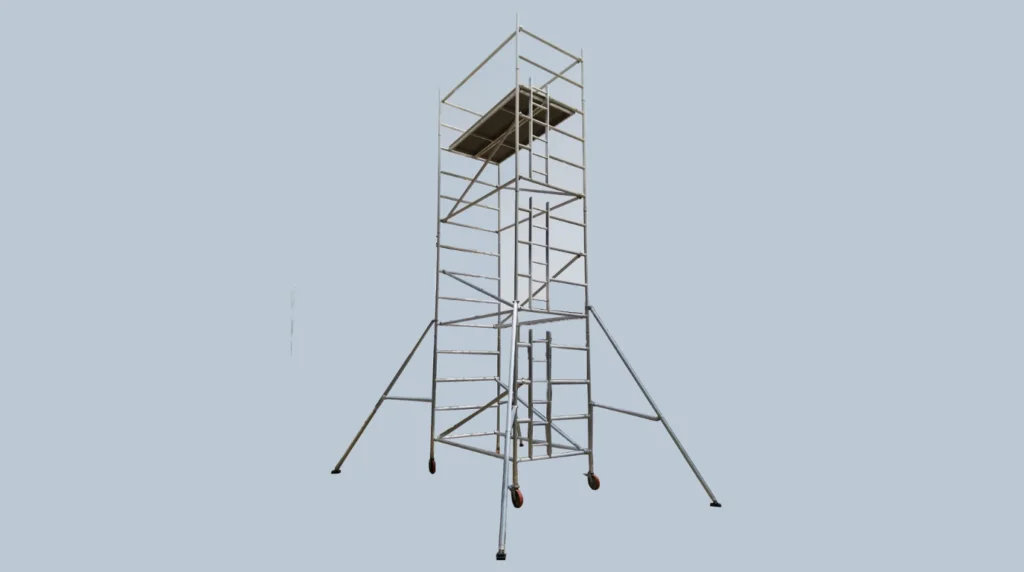
Where the answer is a scaffold, the same care is needed: a tower or a designed scaffold on the face, built to drawings, with the loads checked and the tie positions planned rather than found on the day. That work — surveying the structure, designing the access, planning the loads and erecting the material to a drawing — is what this site sets out in its design and installation services.
The useful first step on any facade is the same whether the final answer is a cradle or a scaffold: describe what has to be reached, how much work is involved, how many people need to be at the face at once, and what the building offers to tie to or hang from. That description decides the system; choosing the system first only decides how many problems you meet later.